The Real Cost of the Generation Gap And Why Most Executives Are Underpricing IT
Every leadership team has a version of this meeting.
Someone on the executive team raises a concern: engagement scores are slipping in one generation. Turnover is unusually high among early-career hires. A high-performing Gen X manager is clashing with her Gen Z direct reports over how feedback should be delivered. A Boomer VP feels sidelined in a strategy session dominated by younger, louder voices.
Individually, these look like isolated people problems. HR issues. Personality conflicts. Something for a manager to "handle."
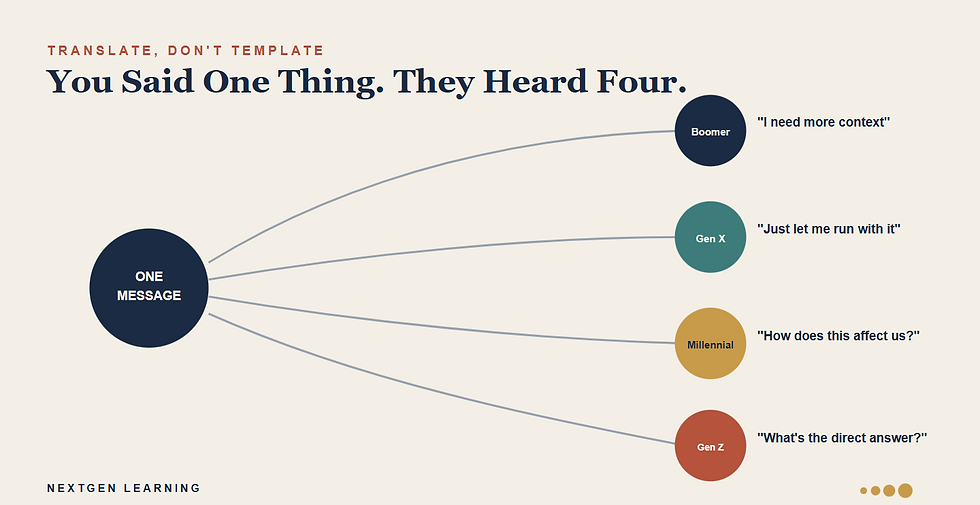
They're not. They're symptoms of the same underlying condition: four generations- Boomers, Gen X, Millennials, and Gen Z are working side by side, often for the first time in history, without a shared operating system for how they communicate, lead, and define success. And the cost of ignoring that condition is a lot higher than most P&L statements will ever show you.

Why This Isn't a "Soft Skills" Problem
It's tempting to file generational friction under culture. Is it nice to fix or not urgent to fix? That framing is expensive.
Consider what generational misalignment actually touches inside an organization:
Retention. When a Millennial or Gen Z employee feels their manager doesn't understand what motivates them, they don't file a complaint — they update their LinkedIn. When a Boomer or Gen X leader feels irrelevant next to younger, faster-moving peers, disengagement sets in long before resignation does. Either way, you're funding the replacement cost.
Succession. Organizations spend years identifying high-potential talent, then lose momentum because the leadership pipeline assumes leadership looks and sounds like it did twenty years ago. Emerging leaders who don't fit that mold get overlooked — not because they lack capability, but because no one's looking for capability in that form.
Speed of execution. Cross-generational teams that don't share a communication language default to friction: repeated meetings, misread feedback, decisions second-guessed instead of trusted. That friction is invisible on a dashboard and very visible in how long it takes to get anything done.
Innovation. The organizations winning right now are the ones getting the full value out of every generation in the room, the pattern recognition that comes with experience, and the fresh instincts that come with distance from "how it's always been done." Miss that, and you're paying full price for a workforce while using half of what it can do.
None of this shows up as a line item called "Generational Misalignment." It shows up as turnover cost, slower time-to-market, a thin bench, and a culture score that HR flags every year without anyone quite fixing it.
The Leadership Blind Spot
Here's the part most executive teams miss: this isn't primarily a frontline problem. It's a leadership problem.
Leaders were trained, explicitly or by osmosis, to lead the way they were led. That works fine when your team looks like you. It works far less well when your team spans a forty-year age range, four distinct sets of formative experiences, and four different definitions of what respect, feedback, ambition, and loyalty actually look like.
The good news is that this is entirely learnable. Leading across generations isn't about mastering stereotypes ("Gen Z wants purpose, Boomers want stability") those shortcuts create as many problems as they solve. It's about building leaders who can read what's actually in front of them and adapt their approach accordingly, without losing their own authenticity or standards in the process.
That's a skill. Skills can be built.
What Closing the Gap Actually Looks Like
The organizations getting this right aren't running one feel-good workshop and calling it done. They're doing three things consistently:
Naming the dynamic out loud. Once leaders have language for what's happening, instead of just a vague sense that "things feel harder to manage lately", they stop taking friction personally and start treating it as solvable.
Building leadership capability at every level. The best emerging leaders in a multi-generational workforce often don't have a title yet. Organizations that identify and develop that capability early build a deeper, more resilient bench.
Making it operational, not aspirational. Real change shows up in how meetings are run, how feedback is delivered, and how change gets communicated. It's not just in a values statement on the wall.
The Real Question for Executive Teams

The question isn't whether your organization has a generational dynamic at play. The real question is whether your leaders are equipped to turn that dynamic into an advantage, or whether it's quietly draining engagement, retention, and execution speed while everyone treats it as background noise.
That's the gap NextGen Learning was built to close. We work with organizations to help leaders at every level build the understanding and skills to lead confidently across all four generations, so the differences that currently cost you time and talent start working for you instead.
If you're ready to find out what that gap is actually costing your organization, let's talk.

Comments