Lost in Translation: The Multi-Gen Meeting
Picture a routine leadership meeting. You deliver an update, lay out a decision, and ask for input.
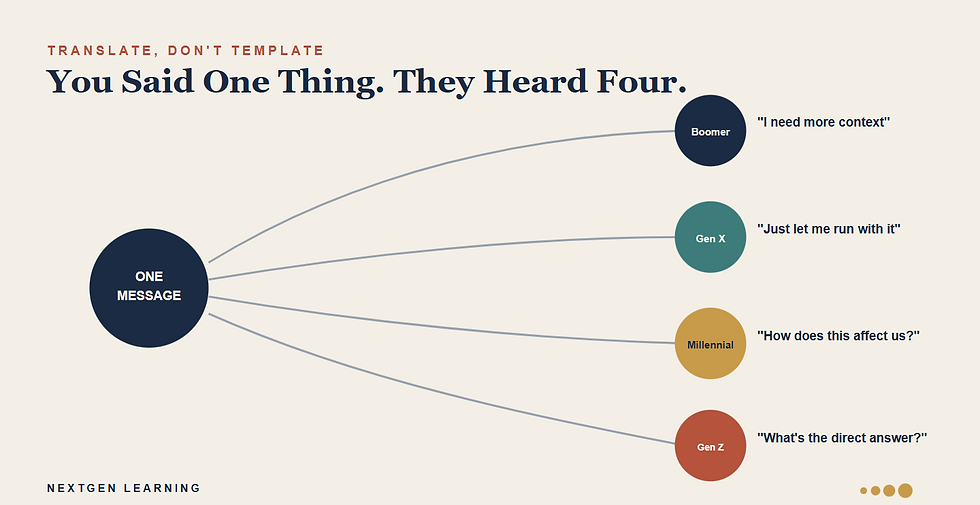
A Boomer director wants the full context before committing to anything. A Gen X manager wants the bottom line and the autonomy to execute it her way. A Millennial leader wants to understand how this connects to the bigger picture and how it affects the team. A Gen Z analyst is waiting for a direct, specific answer to the question they actually asked and finds the conversation circling around it instead.
You said one thing. The room heard four different things.
This isn't a failure of communication skill. It's a mismatch of communication expectations, and it's happening in nearly every meeting, email, and piece of feedback inside organizations that employ more than one generation, which is to say, nearly all of them.
Why "Communicate Clearly" Isn't Enough Advice
Most leadership training treats communication as a universal skill: be clear, be concise, be direct. That advice isn't wrong. It's incomplete.
What counts as "clear" is generationally shaped. A Boomer leader who grew up in more hierarchical, in-person workplaces may read directness as respect and formality as competence. A Gen Z employee who grew up communicating in fast, text-first, low-hierarchy channels may read the same formality as evasive or slow, and may expect transparency delivered in real time rather than saved for a scheduled review.
Neither instinct is wrong. But when a leader only communicates in their own generation's default mode, they're only landing with a fraction of their audience and the rest of the room is quietly filling in the gaps with assumptions, or disengaging altogether.
Three Places This Shows Up Every Week
Running a meeting. Some team members want the agenda and context up front; others want to get straight to decisions and action items. Structuring every meeting the same way, for every audience, guarantees you're optimizing for only part of the room.
Giving feedback. Feedback that lands as constructive for one generation can land as harsh, vague, or performative for another. It's not because the content is wrong, but because the delivery doesn't match what that person is calibrated to hear as genuine and useful.
Communicating change. When a major change is announced, some employees want the full rationale before they'll trust it. Others want to know, plainly, what it means for them and move on. Deliver one version to everyone, and a portion of your workforce will walk away either unconvinced or unclear.
Multiply any one of these by every team, every week, and the tax on organizational speed and trust adds up fast, even though no single instance looks like a real problem.
A Practical Way to Think About It: Translate, Don't Template
The instinct here shouldn't be to build four separate scripts for four generations. That's a stereotype-driven approach that breaks down the moment it meets an actual person. The better instinct is translation: understanding the range of what "clear," "respectful," and "useful" can mean across a multi-generational team, and adjusting delivery accordingly, while keeping the substance and standards consistent.
A few starting principles that apply broadly, regardless of who's in the room:
Lead with the headline, then offer the context — so people who want the short version get it immediately, and people who want depth can keep reading or ask.
Say what's changing and why in the same breath — don't make anyone choose between clarity and rationale.
Ask how someone prefers to receive feedback before you need to give hard feedback — it takes one conversation and prevents months of mutual frustration.
Default to more transparency, not less — across every generation, the erosion of trust almost always traces back to information withheld, not information overshared.
None of this requires abandoning your own communication style. It requires expanding it enough to actually reach the people you're leading all of them, not just the ones who happen to communicate the way you do.

Why This Belongs on the Executive Agenda
Communication mismatches rarely get flagged as a strategic issue. They get absorbed as individual friction. When a manager who "just doesn't click" with part of their team, a change initiative that "didn't land the way we hoped," a meeting that "always runs long for no clear reason."
But add it up across an organization, and generational communication gaps are quietly responsible for slower decision-making, weaker trust in leadership, and disengagement that never gets traced back to its actual source. It's one of the highest-leverage, lowest-visibility problems in a multi-generational workplace — which is exactly why it's worth putting on the agenda deliberately, instead of hoping it resolves on its own.
NextGen Learning helps leaders build the practical skill of communicating across all four generations at once. In meetings, in feedback, and through change, so the message you intend to send is the one that actually lands, for everyone in the room.
If you're ready to make sure your communication is reaching your whole team, not just part of it, let's talk.


Comments